
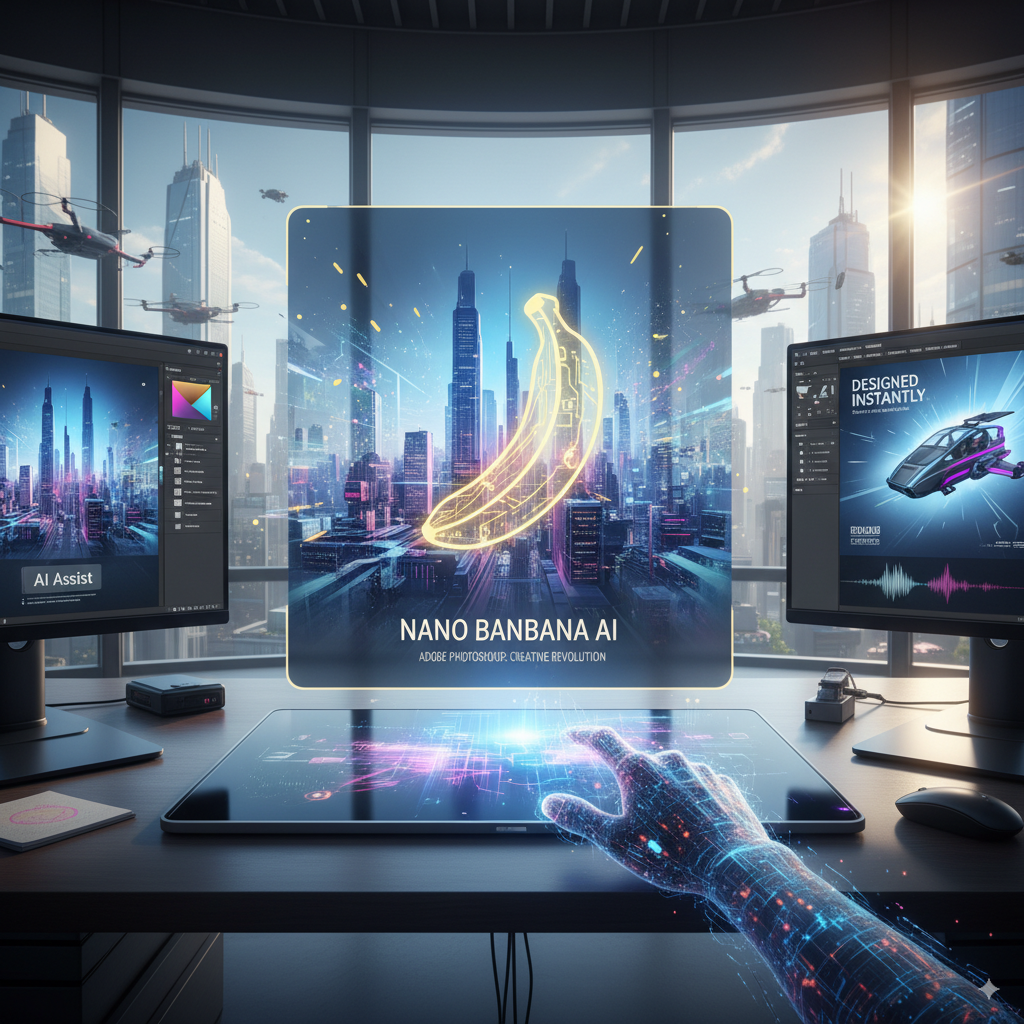
For decades, Adobe Photoshop has been more than just software; it’s been a verb, the undisputed titan of digital creativity. But the ground is shaking. A new era, powered by artificial intelligence, is dawning, and it threatens to upend the entire creative landscape. While Adobe is racing to integrate AI with features like Firefly and Sensei, the real question is what happens when a truly next-generation AI model—let’s call it the “Nano Banana”—arrives.
This isn’t just about adding features. This is a paradigm shift. Imagine an AI so intuitive it understands not just your commands, but your creative intent. The “Nano Banana” represents a future where complex edits are done through simple conversation, where the AI anticipates your needs, and where the line between idea and execution vanishes. In this new world, who will be the ultimate winner: the established king or the disruptive challenger?
The Case for Adobe: The Fortress Isn’t Crumbling
It’s easy to bet against a giant, but Adobe’s position is fortified by decades of strategic dominance.
- The Ecosystem Lock-In: Photoshop doesn’t exist in a vacuum. It’s the heart of the Creative Cloud—a deeply interconnected suite of tools like Illustrator, Premiere Pro, and After Effects. For millions of professionals, this seamless workflow is non-negotiable. Leaving Photoshop means leaving the entire ecosystem, a daunting and costly proposition.
- Professional Trust: From global advertising agencies to freelance photographers, the professional world runs on Photoshop. Its precision, reliability, and powerful tools have built a foundation of trust that newer, sometimes unpredictable AI models can’t yet match.
- Deep Pockets and Data: Adobe has vast resources to pour into R&D. It’s not standing still; it’s acquiring AI startups and training its own models on an immense library of stock imagery and user data, allowing it to integrate AI in a way that feels native to its platform.
The Challenger’s Argument: The “Nano Banana” Uprising
The biggest threat to an empire often comes from a place it doesn’t see. The “Nano Banana” concept represents a challenger built on a completely different foundation.
- AI-Native Advantage: Tools like Midjourney and Stable Diffusion were born from AI. They aren’t legacy software with an AI layer bolted on. This allows them to be faster, more agile, and capable of generating results that feel genuinely magical. A tool built around a “Nano Banana” model would think in AI, not pixels.
- Democratization of Creativity: New AI tools are often cheaper, browser-based, and radically simpler to use. Canva proved that a focus on accessibility could chip away at a professional-grade monopoly. An AI that removes the steep learning curve of Photoshop could attract a massive new user base that Adobe has historically ignored.
- The Disruptive Leap: A “Nano Banana” AI wouldn’t just be better; it would be different. It could offer predictive editing, generate entire compositions from a sketch, or perform hyper-realistic manipulations that currently take hours of manual work. If a challenger can offer a 10x improvement in workflow, even loyal professionals will be forced to pay attention.
The Verdict: Who Will Win in the Years to Come?
The outcome is unlikely to be a simple knockout. The future will probably be a hybrid one, but a clear winner will emerge in terms of market leadership.
The most probable winner is Adobe, but a changed Adobe.
History shows that dominant platforms with massive user bases are incredibly resilient. Adobe’s masterstroke will not be in creating a revolutionary AI from scratch but in its ability to acquire or replicate the “Nano Banana” and integrate it deeply into its existing ecosystem. They will leverage their existing user base as a massive testing ground, refining their AI until it’s “good enough” to prevent a mass exodus. Professionals will get the magic of next-gen AI without having to abandon the familiar, powerful environment they’ve relied on for their careers.
The challengers will carve out significant niches and may even become the go-to tools for ideation and asset generation. However, for the final, polished, professional-grade output, the gravity of the Creative Cloud ecosystem is simply too strong to escape. The winner won’t be the one with the flashiest AI but the one who can best merge that AI with a trusted, indispensable professional workflow. And for now, that advantage remains squarely with Adobe.